Critical Studies
Dead Keen: Robert Graves, the Banshee and the Irish Art of Lament
Abstract: I discuss Graves’s war-time poem ‘Night March’, unpublished in his lifetime, in terms of the mythic symbol of the banshee, a supernatural woman whose wailing or keening foretells the death of someone, traditionally a member of a particular Irish family. I also find a concurrence between Graves’s Hecate and the banshee and between the cry of the banshee and Graves’s figurative death in the war.
Keywords: Banshee, ‘Night March’, keening, ritual, death
__
I am going to begin with two quotes: the first is the more familiar W. B. Yeats assertion taken from his privately published 1925 esoteric work A Vision: ‘the living can assist the imaginations of the dead’
In this augur of death by an owlish company, we find mortality ventriloquised by the birds –– here the owl inhabits Graves’s specific visionary experience. For the owl is companion bird to the Morrigan, compound Irish goddess of mortality, and Graves’s transposition of bird song into the night call of a death-summons is both subtle and knowing. ‘Morgan in Irish legend’, he writes,
is ‘“the Morrigan”, meaning “Great Queen”, a death-goddess who assumed the form of a raven.’
Equally, Oxfordshire-based fairyologist Katharine Briggs quotes fairy researcher W. Y. Evans-Wentz, whose papers on fairy lore are currently held in the Bodleian Library, as stating that the triple-goddess of the Morrigan was compounded in the single form of a hoodie crow. ‘The mythology has declined into folklore, and a crow perching on a house is often the form taken by the banshee or fairy woman.’
But what of owls? Lysaght concludes that individuals who claimed to have encountered the banshee in the form of a bird, drew their own conclusions in terms of type. Further, she notes that ‘the being was, for a variety of reasons, believed to be seen mainly at night-time’.
So here we have an Irish-seeming parliament of owlish banshees, eyes shining in the dark, screeching, hooting, crying or ‘wailing’ (as Graves says) a foreknowledge of death into the weary night. And this multiple presence of owls banded together is not the lone, singular presence of the banshee, of course. This is a collective forewarning and as such it carries especial significance. W. B. Yeats predates Graves in his assertion that ‘When the banshee is present and they wail and sing in chorus, it is for the death of someone holy or a great one.’
The land is bare and wide,
A grey sky presses overhead.
Down to the Somme! In fields beside
Our tramping column march the dead.
And it is the triple monosyllable Graves uses at the end of this stanza in its culminating phrase: ‘march the dead’ which is indicative of traditional Irish bardic form where eulogy is sometimes presented in a string of one syllable words to create a finality similar, notes Derick Thomson in his Introduction to Gaelic Poetry, to handfuls of earth being thrown onto the lid of a coffin.
Silence, disquiet: from those trees
Far off a spirit of evil howls.
‘Down to the Somme’ wail the banshees
With the long mournful voice of owls.
And so this is a shielded sounding it seems, nested in poplar trees whose own folkloric usage is concerned with the coffin, the shield. Yet further down the poem, past the banshees, Graves has his poplar trees expire and become themselves malignly possessed:
The trees are sleeping, their souls gone,
But in this time of slumbrous trance
Old demons of the night take on
Their windy foliage, shudder and dance. (Ibid)
This soughing wind is also traditionally indicative of banshee presence in Irish folklore: ‘In certain printed sources the death-messenger’s cry is likened to the sound of the wind,’ observes Lysaght, referencing a mid-twentieth-century archival source from Kerry which states: ‘the north-easterly wind was blowing and whistling lonesomely through the trees like the sorrowful wail of the banshee.’ Now this act of wailing, whistling, crying and moaning of the banshee is, in some remoter parts of Ireland, directly linked to what is commonly known as caoineadh (pronounced keen-yuh), which as a verb directly translates as ‘the keening’, a funereal practice which itself had almost completely died out in Ireland probably around the time the Second World War ended. Arguably, rural traces remained –– probably familially –– but recordings are extremely scant. Those that do exist hail from the 1950s and 60s and can be seen exclusively as performance as opposed to ritual re-enactment; much superstition lay around any invocation of the dead and the keen was treated as a kind of funerary activation code: palpably dangerous to engage in as a real intervention with the dead. The recordings we have, reproduced as ‘Keening: Six Authentic Recordings from Ireland and Scotland (1955–1965)’ are thought to be by individuals who heard parts of a keen and emulated it, or reconstructions by academic researchers such as Breandán Ó Madagáin. The first is sung by Bridget Mullinon the Aran Islands in 1955 (at 3:40 of the recording available at ‘https://www.youtube.com/watch?v=vgts7_b1JWY&t=7s’); the second, an Alan Lomax recording, is a lament for a dead child sung by Kitty Gallagher in Donegal in 1951 (at 9:47) and the final recording is of Barra piper Calum Johnston, a Hebridean tradition bearer born in 1891, singing the bird-based vocable from a Scottish keen: ‘Pililui’ in 1965 (at 11:35).
Now, the etymological origins of the Irish word caoineadh lie in weeping, in somatic water-rituals for the dead; but the keening itself is highly structured. The three-part keen repeatedly invokes the name of the deceased in a deeply murmured summons. This is the first part. Then follows the tuiream, or dirge: a profound evocation of the individual’s character, their virtues, are pronounced. Finally comes the gol, or cry, which is also known as the coronach in Scottish Gaelic; and here emerges an allusion to birdsong in vocables that possibly acted as connective tissue to an afterlife. The keen’s chorus, suggests musicologist and composer John Purser, might have been to ‘establish contact with the otherworld as may have been the case in fairy songs’. This final part of the keen is comprised of imitative avian sounds such as pililui –– evoking the redshank of Jura, a bird associated with death by the islanders; or the vocables och, ochone in Irish Gaelic.
Lysaght usefully outlines the gender of the banshee and the societal role of the keener –– as almost always being female. She writes:
the supernatural death messenger is called ‘bean chaointe (ban kheentuh)’ in several parts of Ireland and means simply ‘a keening woman’ [...] the keen or the wail is one of the most prominent traits in the traditions about the female supernatural death-messenger. Hence bean chaointe is a very apt name for her [...] the death-messenger [or banshee] is [...] often imagined to be a keening woman. (Lysaght, p. 32)
Interestingly, there are many traditional accounts of the banshee being heard three times and three times only: perhaps structurally comparable to the tripartite nature of the keen. And so, where the banshee summons foreknowledge in the individual of an imminent death –– possibly their own –– so too, does the final part of the keen enable the deceased’s spirit to find a pathway to the otherworld.
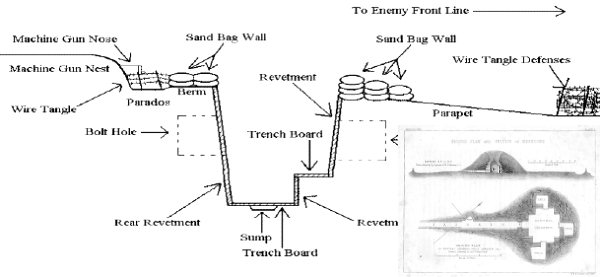
Returning to Graves’s wooded march that comprises his poem, it becomes something of a trudged danse macabre in which the living and the dead are relentlessly pushed on by duty, fatigue and the inevitability of imminent combat. It perhaps serves as an overture to the greater, balder landscape of trench warfare with its stinking craters and man-made subterranean alleyways of mud. In positioning this tramp to the Somme as night-haunted by banshees and perhaps in titling his 1917 collection Fairies and Fusiliers,
New Grange is a flat-topped round barrow, about a quarter of a mile in circumference and fifty feet high [...] Since the old poets record that each rath was presided over by an enchantress and since, as will be shown, the Sidhe (fairies) were such skilful poets that even the Druids were obliged to go to them for the spells that they needed, it seems likely that the original Caer Sidi, where the Cauldron of Inspiration was housed, was a barrow of the New Grange sort. For these barrows were fortresses above and tombs below. (White Goddess, p. 101)
We can compare Graves’s description of the shaft within the barrow as: ‘a narrow passage, sixty feet long, through which one has to crawl on hands and knees. It leads to a small circular chamber’. With these excerpts on trench existence from Good-Bye To All That:
I spent the rest of my watch in acquainting myself with the geography of the trench-section, finding how easy it was to get lost among cul de sacs and disused alleys (p. 136)
We overtook a fatigue-party struggling up the trench loaded with timber lengths and bundles of sandbags, cursing plaintively as they slipped into sump-holes and entangled their burdens in the telephone wire […] I was hot and sweaty; my hands were sticky with the clay from the side of the trench. (p. 130)
It is tempting here to align Graves’s banshee or ‘priestess of the great dead’ as priestess of the Great War –– a presiding poetic presence that shaped his own experience, both pre-cognitively and retro-cognitively. Arguably, inaugurated by the banshee, Graves entered the space of keening itself, residing in the keen’s sonic mantle. And he did die: in a poem titled ‘Escape’, the epigraph reads: August 6, 1916. –– Officer previously reported died of wounds now reported wounded: Graves, Captain R. Royal Welch Fusiliers). And he rightly insists: ‘But I was dead, an hour or more [...] I saw new stars in the subterrene sky’.
We might agree that Robert Graves apparently perished three times in his life –– or would that too neatly correspond to the three rounds of a keen reiterated in the trifold experience of encountering the banshee on his march to the Somme, the Somme itself an upended sithichean barrow, and –– by implication, the keen in his mother’s heart on hearing the false news of his death.
Kirsten Norrie has written four critically acclaimed poetry collections and two pamphlets under her Highland matrilineal name MacGillivray: The Last Wolf of Scotland; The Nine of Diamonds; The Gaelic Garden of the Dead; Ravage; The Demon Tracts and Until the Twilight Fails. Her forthcoming non-fiction books are Scottish Lost Boys, Eight Renegade Essays (forthcoming from Strange Attractor Press, 2027) and Eagle Song (Wilton Square Books, 2028) and her novels High Aconite and American Book of the Dead (Wilton Square Books, 2027). She has three degrees from Oxford University, and her work has appeared in The Guardian, TLS, The Scotsman and on BBC Radio 3’s Late Junction and the Verb programmes. She was an AHRC Kluge Fellow at the Library of Congress, a 2019 recipient of a Foundation Jan Michalski writer residency in Switzerland, and the 2024–5 Judith E. Wilson Poetry Fellow at Cambridge University. Her poetry is taught as part of the SQA Scottish Highers curriculum and a permanent archive of her poetry is held at the Scottish Poetry Library. www.kirstennorrie.com.
NOTES