Critical Studies
‘Only Connect’: Robert Graves and the Munich Crisis of 1938
Abstract: In this article connections are made between a personal project — the putting together of an anthology of poems written in response to the ‘Munich Crisis’ of September 1938 — and the ‘times and places’ concerns of the 2026 conference. These connections involve looking at the history and geography of a group of poems, rather than the close reading of an individual work. I propose that we consider the poems written by Robert Graves at a certain time, to be defined in my first part, and in a specific place, to be discussed in my second part. These fact-checkable considerations will give way, in a third part, to what for poetry anthologists is the most interesting aspect of ‘place’, which is the question of collocation, the effects obtained by the placing together of poems, their arrangement side by side in the public space of print. What connections can be made when poems are experienced not in splendid isolation but as parts of a poetic sequence? What insights emerge from such connections?
Keywords: appeasement, collocation, connections, Munich Crisis, poetic sequence, ways of seeing
__
I ‘These were all lies, though they matched the time’
In a narrow sense, the ‘Munich Crisis’ refers to the third in the series of three meetings which took place in the second half of September 1938, to deal with the pressing question of Hitler’s apparent determination to occupy by force the Sudetenland, that part of Czechoslovakia in which German-speaking people were a majority. The first two meetings between Neville Chamberlain and Adolph Hitler were actually held in Berchtesgaden and Bad Godesberg, but it was the highly dramatized third meeting in Munich, where they were joined by Benito Mussolini and Edouard Daladier, that resulted in the Four Powers agreeing to the German occupation of the Sudetenland in exchange for Hitler’s solemn promise that this would be the last of his territorial demands. Chamberlain flew back to England to wave a paper guaranteeing ‘peace with honour’ and ‘peace in our time’. As Graves later sardonically commented, here was material proof that ‘the umbrella had been mightier than the sword’.
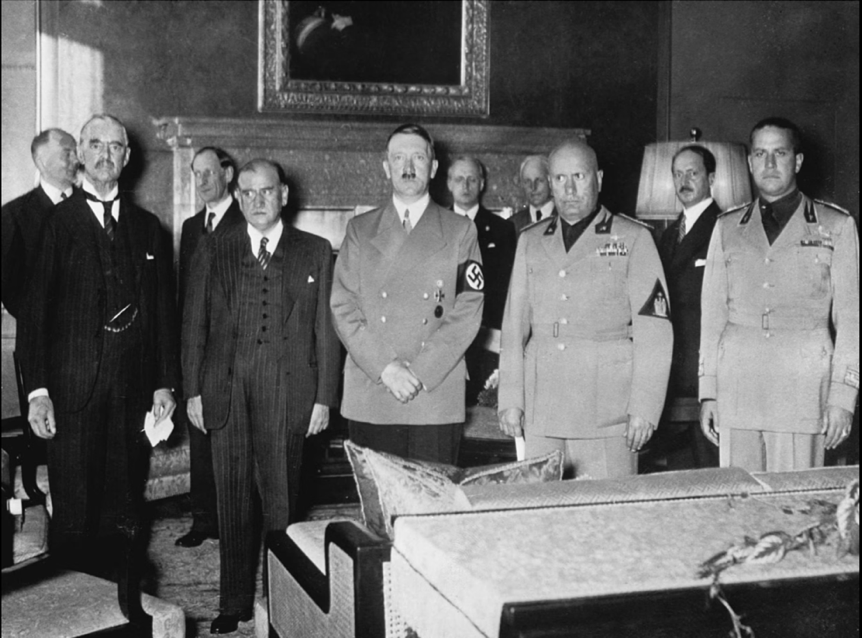
Public opinion, vociferous and well-monitored, was sharply divided over both the morality of what had been done to an ally and the efficacy of attempting to avert war by appeasing an unpredictable and perhaps insatiable bully. But whether one was pro-munichois or anti-munichois, the Munich Accords were immediately seen as a turning-point, for good or bad, in the long march to peace or war. When Hitler broke the Accords by annexing the rest of Czechoslovakia in March 1939, provoking France and Britain to offer face-saving guarantees to Poland, war once again seemed to many more likely than not. After Munich, and depending on one’s politics, many felt that they were living either on borrowed, or on stolen, time.
On 10 June 1939 E. M. Forster published in the New Stateman and Nation an essay in which he gave an arresting account of his own response to Munich, one which admirably conveys the reaction shared by many, including Graves: an immediate and shameful sense of wrong, followed by a feeling of powerlessness to right that wrong, leading to the conclusion that the only thing to be done is cultiver notre jardin. The passage is worth quoting in full, since it captures so well the tragic, all-too-human bathos of such a decision at such a time:
I was in London that dark Wednesday night when the news of an agreement between them seeped through. It was good news, and it ought to have brought great joy; it did bring joy to the House of Commons. But unimportant and unpractical people often foresee the future more clearly than do those who are engaged in shaping it, and I knew at once that the news was only good in patches. Peace flapped from the posters, and not upon the wings of angels. I trailed about reading the notices, some of which had already fallen into the gutter. On the Thursday I returned to the country, and found satisfaction there in a chicken run which I had helped to build earlier in the week.
Forster went on to define the post-Munich mood. This he characterized as ‘the state of being half-frightened and half thinking about something else’. Conceding that ‘These mixed states are terrible for the nerves’, he went on to observe that ‘We are worried rather frantic’. But worry, in Forster’s view, was worse: worry tempts its victim ‘to simplify, since through simplification he may find peace. Nagging and stinging night and day, [worry] is the undying worm, the worst of our foes’.
Robert Graves offered his own account of the Munich crisis and its importance in The Long Week-End, a work co-written with Alan Hodge during the phoney war. Graves’s account tallies with that of E. M. Forster: like the novelist, the poet sees Munich as opening the way to a year of unpleasantly mixed states:
The eleven months which came between the Munich Conference and the German invasion of Poland were a confused and inglorious period. Immediate sense of relief was followed by a feeling of humiliated anger, and then by a purblind apathy.
Further on, he extends the time period of eleven months to two years (presumably 1937–1939, a view shared by several historians)
Like everyone else in the last two peace-years, the poets in general were in a state of expectant, fearful, inactive confusion. A few, however, contributed to the big critical compendium The World and Ourselves, edited by Laura Riding in 1938, the conclusion of which was that the tragic absurdity of public events was due to a moral failure among ‘outside people’ — the institutionally minded directors of affairs; but equally to a failure among independent minded and sensitive ‘inside people’ — who should include most women and all poets — to give the outside people a lead. The remedy suggested was a continual insistence by the inside people on personal integrity — an attitude to be communicated from friend to friend through the close network of real friendships that made up society.
My own anthology has to be equally flexible with the notion of ‘pre-war poetry’. Its working title is Poets and Poetry in the Year of the Munich Bother, an allusion to a line from a sonnet by Patrick Kavanagh, ironically entitled ‘Epic’. While maintaining the focus on the immediate aftermath of the Munich Crisis, my year runs from May 1938 to June 1939. Loosely adapted to each featured poet, this timeframe works historically because it takes as its starting point the ‘May Crisis’ of 1938 when, after his state visit to Italy, Hitler signed a directive announcing his ‘unalienable decision to smash Czechoslovakia by military action in the near future’. The diplomatic crisis set off by this violent language led to the Runciman Mission and Report, the Nuremberg and Berlin rallies, the Munich Accords, Kristallnacht, the fall of Madrid, the annexation of the rest of Czechoslovakia, the guarantees to Poland, and the signing of the Pact of Steel in May 1939. On the literary side, these last years of peace can be framed by the publication of W. B. Yeats’s New Poems in May 1938, and the posthumous publication in June 1939 of the extraordinary Last Poems and Two Plays.
In practice, setting a time-frame was not nearly as difficult as locating the poems which fell within it. How to know exactly when a poem was written? Poems are more often than not undated, and are often found scattered among diverse publications, or even uncollected. Literary detective work is required, and recourse must perforce be had to other primary sources. In the case of Robert Graves, happily, we can use the information provided by the many prose works he co-wrote with Laura Riding during this period, by the letters he wrote at the time and, most helpful of all, by the fact that from February 1935 to May 1939, he kept a diary.
The diary bears out Graves’s idea that ‘Munich’ was indeed ‘a confused and inglorious period’. Interestingly, the very first entry for February 1935 begins with the poem that became known as ‘Recalling War’, reminding us that for First World War veterans like Graves, war and rumours of war were not an abstract proposition but a re-awakening, often physical as well as mental, of painful memories. The entry for 24 September 1938, at the height of the Crisis, picks up on the themes of ‘Recalling War’, the hopes and fears of a wounded generation:
Sept 24
Rain all day and notices out calling up all French reservists of category 3 i.e. 2 classes.
… I went to a dentist early at Montauban: he said toothache was only sciatic nerve — the tooth was dead. We all have twinges of rheumatism here.
Dictionary all day.
We do not expect war in any serious sense.
More generally, the diary reminds us that, to understand the Munich moment, we need to bear in mind the wider international context. Graves not only mentions the Crisis-related elements listed above, but he also records the fall of Canton and Hankow, in October, and meticulously notes down the battles of the Spanish Civil War. Concerning the latter, he expresses surprisingly little emotion. The one comment he does make is both characteristic of the Riding-Graves’ disdain for party politics, and typical of the soldier’s refusal to discuss such things; it occurs when reporting a reunion on 13 March 1939 with recently-escaped Majorcan friends: ‘Glad that there was no political talk: but they told us of the dreadful conditions in the Spanish refugee camps and the brutality of the French police.’
Otherwise, the diary tends to recount the more or less trivial pursuits which, when they were not writing or revising their work, made up the days of Graves, Riding and their small circle of friends.
Above all, the diary allows us to re-arrange the poems in chronological sequence. Here they are, in the order in which they were written, one after the other, during the historical period — ‘the year of the Munich bother’— stretching from July 1938 to May 1939:
1. Being Tall (July 24–28, 357)
2. Assumption Day (August 16–18, 767)
3. The Fallen Signpost (August 20, p. 367)
4. The Worms of History (October pp. 12–15, 390)
5. To Sleep (October 22–24, p.389)
6. The Suicide in the Copse (p. 395)
‘A poem about pursuit and leisure’ (November 19–21, 1938, untraced)
7. The Glutton (January 6-11, p. 387)
8. Dawn Bombardment (January 10–11, p. 390)
9. A Stranger at the Party (January 20, p. 396)
10. A Love Story (February 4–8, p. 387)
11. Frightened Men (February 8–9, p. 395)
12. The Thieves (February 19–20, p. 388)
‘Poem to Laura in one draft’ (March 5, untraced)
‘A poem about remembrance’ (April 26–May 1, 1939, on board ship, untraced)
13. The Moon Ends in Nightmare (May 1939, p. 768)
The wide span of page numbers give some idea of the dispersal of the poems as they are now encountered.
Setting aside the questions raised by the poems mentioned in the diary but not (yet) traced, the baker’s dozen which remain have a single important feature in common: they were all (except the last) written out of the same place. And so, in a second part let us turn to the question of place ….
II ‘A house not his own’
Geographer and poet Tim Cresswell defines ‘place’ as ‘meaningful space’, space to which we variously lend meaning. He approaches this idea of place from three directions: place as location, as locale and as ‘spirit of place’, and so shall we.
The location out of which these poems were written lies in the French countryside, near the very small town of Montauban-de-Bretagne (48°12” N, 2°03” west), some 30 km. north-west of Rennes. In July 1938 Riding and Graves chose to wait out the Spanish War which had driven them from their home in Mallorca, in Brittany for the usual financial reasons, but also to be near Spanish-speaking friends and Mallorcan fellow-exiles. Not finding suitable accommodation in Rennes itself, they decided to rent the Chateau de la Chevrie which, for nine months became for them a locale.
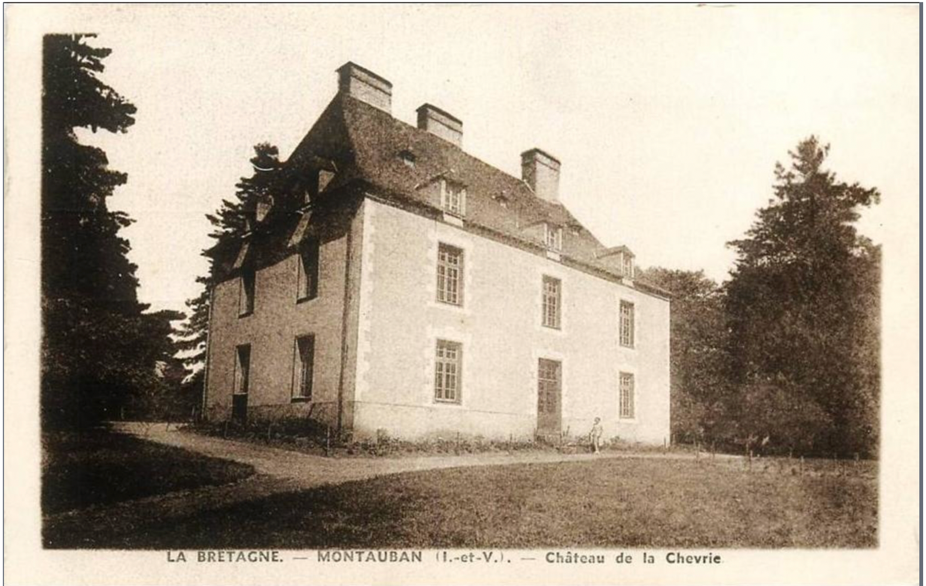
The above photograph exists in the form of a postcard enclosed among the August 1938 entries in Graves’s diary. The inside of the house, which cannot be seen in the photograph, was described by Graves, in prose rather than verse: ‘12 main rooms furnished and outside sanitation: no electric light, a deep ivy-covered well, 10 acres of grounds, including a waterlily lake; parquet floors, sentimental wallpaper, rats until we get a cat.’
What can be seen in this postcard, is that the Chateau de la Chevrie is not so much a chateau as a manor-house, more Laufzorn than Aufsess Castle.
In France the common definition for a chateau is that it is a building that can boast at least one tower, so perhaps the most striking feature here is that there is no tower: neither a leaning tower, nor a fallen tower, still less Thoor Ballylee or ‘The Black Tower of Yeats’s last poem. Does that absence place Graves in the same despondent state as Gérard de Nerval? Je suis le Ténébreux, - le Veuf, - l’Inconsolé, | Le prince d’Aquitaine à la tour abolie.
In the absence of a tower, the most striking architectural features are the windows and door. These exits and entrances do feature in some of the poems, where they relate to the question of inside/outside people. In ‘To Sleep’, for example, the window is a frontier space which lets in unwanted strangers (the bats) and keeps out the curious (the birds).
Now that I love you, now that I recall
All scattered elements of will that swooped
By night as jealous dreams through windows
To circle above the beds like bats,
Or as dawn-birds flew blindly at the panes
In curiosity rattling out their brains —.
Another poem, originally entitled ‘The Hostages’ before becoming ‘Dawn Bombardment’, is reminiscent of this same incident. In it the windows extend the inside/outside dichotomy cited above and which runs like a thread through the poems. In Graves’s poem the inside people (‘captives’) welcome disturbances from outside because they represent not further danger but the possibility of rescue. The attempts on the part of petty creatures to get into the house turn into a large-scale assault, in which the window becomes a defensive casemate, or perhaps a magic casement:
Guns from the sea open against us:
The smoke rocks bodily in the casemate
And a yell of doom goes up.
We count and bless each new, heavy concussion—
Captives awaiting rescue. (Complete Poems, p. 389)
The poem was written as a gift from Graves to Laura Riding on 26 January, her 38th birthday. It received no answer until early March. When Laura finally did reply, in the form of a letter, she chose to ignore Graves’s play on her own idea that they were both, or all, hostages to history. Instead, she prosaically dissected her erstwhile lover’s predicament in sexual terms. To quote Richard Perceval Graves’s excellent account:
His poem, she told him, contained a quite erroneous view of his present situation. He should under no circumstances consider himself to be a hostage in some besieged stronghold. In her view, the stronghold only imagined that it was under attack from the sea: the guns were really its own; and Robert’s feeling of being imprisoned would disappear as soon as those guns were fired, and the fortress windows could be used for looking out.
We do not know whether Robert took advantage of Laura’s advice, but he certainly suffered from the icy indifference with which it was given. The last lines of both ‘Frightened Men’ and ‘The Moon Ends in Nightmare’ are eerily identical, and give some idea of what it felt like to be shut out by unrequited love:
The worst is when they hide from us and change
To something altogether other:
We meet them at the door, as who returns
After a one-hour-seeming century
To a house not his own. (Complete Poems, pp. 395, 768)
Is worry (‘nagging and stinging night and day’) the spirit of place which predominates at Venison Hall? The very name has Gothic possibilities, but this is no Castle of Otranto. There is a ghost, and historical records are discovered, but these come to nothing. Indeed, the incidents of mild domestic drama, recorded in the diary, tend to bring to mind Northanger Abbey rather than Gormenghast.
Nor is Venison Hall a late 1930s version of Wolf Hall. Even Riding’s earnest work on the Protocols could not turn this French hunting lodge into a locus of political intrigue,
Towards the end of their stay, in a letter to his son David, Graves compresses his view of Venison Hall into a single sentence: ‘This place has been extraordinarily good for work and general placid pleasures.’
Setting aside the contrapuntal allusion to John Donne’s ‘The Good-Morrow’ contained in ‘placid pleasures’ and the all-too-apposite ghost-rhyme in ‘placid’, we might infer from this terse judgement that the stay in Venison Hall was yet another version of pastoral. The poems, however, always more truthful than the poet, tell a story that is rather more sinister. In them we find no celebration of the longstanding and self-contained harmony celebrated in the country-house tradition of Ben Jonson and Andrew Marvell. Taken as a whole, the poems are anti-pastoral, riddled with a semantic field of morbidity, of gallows-humour, of night-thoughts. They are haunted by allusions to other literary places of psychological suffering: in addition to the melancholy of Gérard de Nerval’s sonnet and Keats’s ‘Ode to a Nightingale’ mentioned above, we might add allusions to the graveyard scene from Hamlet, Shakespeare’s sonnet 94 (‘They that have power to hurt and will do none’), George Herbert’s ‘Love bade me enter’, and G. M. Hopkins’ ‘I wake and feel the fell of dark, not day’.
It may be that it was not so much the Chateau de la Chevrie, the place, as the place-name ‘Munich’ which frightened Graves. Jean-Paul Sartre exempted the genre of poetry from his general decree that literature should be engaged in politics, doing so on the grounds that allusions in poetry were too personal to be of any political use. Interestingly, the example he gave was what the word ‘Florence’ meant to himself:
Florence is a city, a flower, and a woman; she is city-flower, city-woman, and flower-girl, all at once. And the strange object that appears from this possesses the fluidity of a river, the gentle wild ardor of gold, and finally abandons itself with decency and prolongs indefinitely, through the continuous weakening of the silent e, its blossoming full of silent promise. Added to this is the insidious effort of biography. For me, Florence is also a certain woman, an American actress who starred in the silent films of my childhood and whom I have forgotten everything about, except that she was as long as an evening glove and always a little weary and always chaste, and always married and uncompromised, and that I loved her, and that her name was Florence. For the word, which tears the prose writer away from himself and throws him into the midst of the world, reflects back to the poet, like a mirror, his own image.
If we transpose that idea to what ‘Munich’ might mean to Graves in 1938, we awaken not only an all-too-relevant play on the German word münchen meaning ‘the place of the monk’ but also the memories of the sinister, even terrifying, place described in Good-bye to All That:
Munich we found sinister — disgusting fumes of beer and cigar smoke and intense sounds of eating, the hotly dressed, enormously stout population in the trams and trains, the ferocious officials, the wanton crowds at the art shops and picture galleries. Then there was the Morgue. We were not allowed inside because we were children, but it was bad enough to be told about it. Any notable who died was taken to the Morgue and put in a chair, sitting in state for a day or two, and if he was a general he had his uniform on, or if she was a burgomaster’s wife she had on her silks and jewels; and strings were tied to their fingers and the slightest movement of one of the strings would ring a great bell, in case there was any life left in the corpse after all. I have never verified the truth of all this but it was true enough to me. When my grandfather died about a year after our last visit I thought of him there in the Morgue with his bushy white hair, and his morning coat and striped trousers and his decorations and his stethoscope, and perhaps, I thought, his silk hat, gloves, and cane on a table beside the chair. Trying, in a nightmare, to be alive but knowing himself dead.
Unlike the diary, the poems contain a distinct undertone of uneasiness. The poems written at Venison Hall are not celebrations of rural peace and ‘country pleasures’ but a personal landscape, thirteen glimpses into a mind suffering from the first tremors of ‘a moonquake’, and coming slowly to the end of its tether. These intimations that all was not well were not yet the sharp pangs of certainty: the ending of peace was not yet the outbreak of war. However retrospectively obvious the course that the events of Graves’s personal life and European politics were taking, at the time omens could still be ignored, metaphorically enveloped in snow, wrapped in what Graves later called ‘the cotton-wool of Munich’.
III ‘Loving in part, I did not see you whole’
The self-evident unities of time and place have so far encouraged us to consider a certain number of poems as a group. Out of these unities springs, I have suggested, a dark unity of style, or mood, one which is ‘worried rather than frantic’. In order to learn more about the source, or sources, of this unease, we need to apprehend ‘place’ as a verb, to examine the question of collocation, the placing together of poems within the self-contained space of a printed poetry book, or pamphlet.
Is a new energy released when a poem is read as a part of a group, rather than in splendid isolation? The editor of A Companion to Twentieth-Century Poetry certainly thought so, since he offers as one possible perspective on modern poetry, a series of ‘Readings’ of eighteen selected poetry collections, one of which was W. B. Yeats’s 1928 collection The Tower.
The texts chosen are best considered as a selection of the most influential, widely discussed and characteristic poetry of the period, the concentration on specific volumes a recognition that even the most canonical poetry is born of a particular historical moment.
If Graves’s work is barely mentioned in the Companion, it is perhaps at least partly because he so frequently published his poems in the form of successive Collected Poems. These constitute a series (1938, 1948, 1955, 1961, 1965, 1975) of new and selected poems, the poems themselves being sometimes individually revised and always re-arranged into an apparently neutral numerical, rather than a thematic, order. Collected Poems do not engage the reader in the same way as stand-alone slim volumes do: for the reader, they are spaces, rather than places, of publication. Happily, however, readers can write back, for they as well as writers can create, retrospectively, a meaningful space for poetry.
The placing of poems in a new and meaningful space is the reader-anthologist’s pleasure. He sat in the meadow and plucked with glad heart the spoil of the flowers, gathering them one by one.
Similarly, what I am proposing as a ‘Munich sequence’ offers a reading experience which is greater when the poems are read together rather than separately. Some hints as to why this is generally so are to be found in a study, unique of its kind, published over forty years ago. In The Modern Poetic Sequence: The Genius of Modern Poetry (1983).
One of the tropes much applied to the 1930s is Antonio Gramsci’s idea that this was a time of transition between ‘an old world dying and a new one struggling to be born’. Such a view is conducive to the idea, espoused by Graves’s first three biographers, that the time spent in Brittany was one in which Graves’s love for Laura Riding was dying, while a new love for Beryl was being born. There is some evidence in the diary that Graves was not indifferent to the young and beautiful secretary who was now part of the household circle, but there is little trace of a new love affair coming to life in the lyric sequence I have proposed. Poems addressed exclusively to Beryl come later and are mixed up with other poems, including nine of those on our list, in Poems 1938-1945. The poems which make up the lyric sequence written in Brittany during ‘the year of the Munich bother’ are all addressed not to Beryl but to Laura and can, I believe, best be understood as thirteen ways of not looking at a crisis or, as we shall see, two crises.
Rosenthal and Gall posit that the predecessors of the modern lyric sequence are the sonnet collections of Petrarch and Shakespeare. Graves’s poems are not of course sonnets but, when read as a lyric sequence, they become Graves’s version of Petrarch’s Sonnets to Laura. The poems function as burnt offerings to a dying, perhaps dead, partnership, self-bruising complaints against a lady’s cruelty, doomed appeals to her kindness. They that have power to hurt and will do none. Two poems are key to the Petrarchan theme. ‘Assumption Day’, written in August, is not only a poem about ‘being cross’, but also one about being ‘crossed’, betrayed, by ‘one who should know better’. And indeed, crosses, cruxes, and crossroads are persistent images in the Munich sequence. ‘A Love Story’, written in March, is even more bitter about ‘the chill ramparts’ on which the spurned lover has been left, disconsolate, to dwell. All the other poems enact the various ways in which the poet attempts to win back his lady’s favour. Through flattery, by offering Laura expressions in verse of what he thinks are her own ideas, as in ‘The Worms of History’, ‘The Glutton’, and ‘Dawn Bombardment’. Through self-mocking irony in ‘The Suicide in the Copse’. Through wit and humour in ‘The Fallen Signpost’ and ‘The Thieves’. Through a veiled warning in ‘The Stranger at the Party’.
The Petrarchan theme is eminently compatible with a biographical reading. To Patrick Quinn’s brilliant exposition of the morbid state of the relations, both physical and intellectual, between Laura and Robert already by 1937,
Graves had decided to tell the story through Antonina, Belisarius’s lively, strong-willed wife, who sometimes went into battle with him and, on occasion, persuaded the Empress to take Belisarius’s side against her mean-spirited husband Justinian. Riding proposed that Graves should put the narration into the mouth of a fictitious slave, a eunuch in the employ of Antonina.
My broad-brush indications of the intended and actual functions of these spurned love-poems can be borne out by close readings of each poem but it is not to my present purpose to do this. What interests me more is that such a reading allows us to extend a biographical (or psychological) reading into a historical one. If the poems are read as evidence of the birth of a new and soon-to-be durable love affair with Beryl, then there is no useful comparison to be drawn between what later becomes the ever-more-hopeful direction of Graves’s personal life and the actual slow slide of the political world into war. But if the poems are read as the worried and finally frantic responses to the slow death of Laura’s love for Graves and the birth of her imagined and later consummated love for Schuyler Jackson, then useful historical parallels can be made. Indeed, it quickly becomes clear that Graves’s response to a crisis in his personal life mirrors his response to the public crisis which we call ‘Munich’.
In fact, Graves was refusing to look two crises in the face. His diary bears out the view of some historians that there was nothing special about ‘Munich’; it was just one of a series of crises.
It is rather queer in a comic way, going to the States now — because we would not go if we thought there was going to be a European war, and my mother writes how glad she is that I am going to safety and everyone in England thinks the same, of the general population, — I mean, how lucky people are who can get a steamship ticket out of Europe—anywhere!
Throughout this year, Graves maintains the constant and crucial conviction, highly unusual at the time, that war was not impending.
The personal is inseparable from the political. Read sequentially, the poems become variations on the theme of Appeasement, and thus the connections are not hard to make between what was or was not happening at Venison Hall and what was happening, or not, in the world at large. Graves’s description of ‘the eleven months which came between the Munich Conference and the German invasion of Poland’ as ‘a confused and inglorious period’ is as true of his personal life as it was of European public life.
Does that mean that Graves, like Chamberlain, was a Guilty Man, unable or unwilling to see what was going on under his very nose? In certain ways, yes. Determined to live unbothered by the outside world, the ‘inside people’ could not see the need for real social change and could not understand that if that change did not emerge from within the body politic, then it would be imposed from without. Until it was admitted that the old social order was dying, and deservedly so, then no new order could be born. For such people, ‘the year of the Munich bother’ was not so much a time of transition as a ‘year of magical thinking’, magical in the anthropological and pre-historical sense, meaning the belief that if a person hopes intensely enough for something, and performs the correct ritual actions, then an unavoidable event can be averted, or reversed.
Quite clearly, this is what Graves was attempting to do in, for example, ‘A Love Story’, just as it is what Chamberlain was attempting to do in Munich. Both were performing on paper a homage to what they earnestly hoped would be an unevent: not the end of an affair, not the end of Pax Britannica. Why were both attempts unsuccessful? Because, in order to succeed, pacts must be ‘reciprocally made’, between adversaries who have sincerely understood and made compatible their differences.
We remember that Graves described the final post-Munich state as one of ‘purblind apathy’. It is worth re-placing an essay he wrote in 1939, entitled ‘How Poets See’ within the context of ‘the year of the Munich bother’. Here is what he says about the partiality of his own eyesight:
In looking at any object, for example a house or a person, I concentrate my gaze on what I choose as the central point and focus it clearly, allowing the rest of it to form a blur —of which however I apprehend the extent and general colouring. If after studying the central point I am still interested in the object, I look for other points of interest: thus, after long acquaintance with a person I know his single features by heart, but cannot recompose his face in memory. I must always have seen in this partial way, because when thinking of the house where I spent my childhood, I remember the shapes of the window-frames, the look of particular bricks in the wall, the angle of the slate roof, but cannot recompose the general façade.
Whether looking into Venison Hall, or out of it, into or out of the gathering storm, Graves failed, or perhaps refused, to see ‘the general façade’. But in this purblind view, he was far from alone.
And so we come back at last to Forster’s injunction: only connect.
Helen Goethals is an Honorary Professor of Commonwealth Studies, who taught at the universities of Lyon and of Toulouse. Her research is focussed on the many, and often surprising, connections to be made between poetry and politics. As well as having written many peer-reviewed articles and edited a number of multi-author volumes, she is the author of The Unassuming Sky: The Life and Poetry of Timothy Corsellis (Cambridge Scholars Publishing, 2012). She is currently co-organizing an international conference in Paris on the theme of Indian Poetry and the Representation of Justice.
NOTES