Biographical Studies
Interview with Bronwyn Drainie and Kathryn (Drainie) Pastor
Abstract: Robert Graves Oral History Project interview with Bronwyn Drainie (“Bron”) and Kathryn (Drainie) Pastor (Kathy). 15 September 2025. The following is not a complete transcript of the interview, but a long excerpt revised and edited for publication. Questions prepared by JonArno Lawson and Michael Joseph; primary interviewer, Joseph.
Keywords: William Graves, Deià, John Drainie, music
__
JonArno: When did you first visit Deià? How old were you?
Kathy: I think I was 16. I was invited there by William. I met William at our house, because his good friend Pedro Pisa brought him. I would have been 16, Bron, 17 and, the way we met was through music. As you probably know, William is very musical. So is Pedro. And Bron and I loved to sing together back in those days. So, Pedro said, ‘you must meet these two sisters who love to sing together.’ So we sang some songs and that’s how we met William.
After that William invited us up to one of the big parties in Deià and shortly after that he brought me to Canellun to have dinner with the family.
Bron: Tout mal chaussé, tout mal vêtu.| Brave marin, d'où reviens-tu?
Kathy: That was the first verse. The second verse was almost identical, and that was all he taught me. Beyond that, William very kindly brought me up to Canellun a few more times. And we went down to the Cala. I have a picture that William took of me in the Cala. In William’s book he describes how, when they first came to Mallorca Robert would walk down to the Cala every day for his swim.
But it was Robert who walked me down to the Cala one summer day. We sang songs as we walked, and we talked about the upcoming party. I was invited because he and I shared a birthday. Well, several of us did. We were all born around the same time, July 21st, 22nd, 23rd, 24th. Mine was 23, Robert’s was 24, I think William’s was 21 or 22, Lucy, as well, a number of them [the Graveses] had birthdays during that week so that’s why they threw the birthday party every year at that time. Anyway, you asked me when I first visited Deia. I was 16, about to turn 17.
JonArno: Do you remember what songs the two of you sang for William?
Kathy: Oh gosh, maybe Canadian songs like Un Canadien errant. That would have been one, or À la claire fontaine,
Kathy: Bron went out with Po. I was engaged to Teddy for a year or two. And we all sort of hung around together.
Bron: Any other songs?
Kathy: Oh, there were lots of them. There was, El Huaquero, a Peruvian song.
JonArno: Was it recorded? Do you know if they did any recordings?
Kathy: They did record, but I cannot find our copy of the one record we had. It was called Los Valldemosa.
Bron: But who are the musicians in that picture? [Shows a second photo showing music-making on the Graves’s terrace]
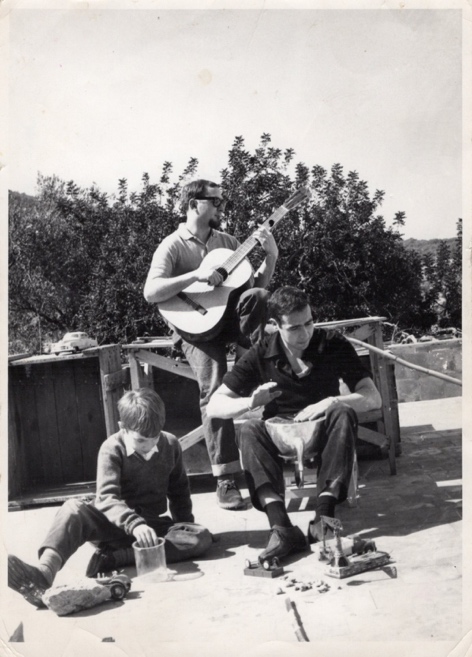
Bron: Tomas is the one Graves member of that group.
Kathy: Tomas is the youngest. Several years younger than the others. And, of course, Ramon, the drummer, was married to Lucy.
Michael: What year was that?
Kathy: 1963, I think. Here’s a picture of Canellun, with the Teix behind,
JonArno: Do you remember what you had for dinner that night?
Kathy: I do not remember, but it was something prepared by Beryl. She was very welcoming to people, and I got the feeling that it was open house, almost, that whoever the kids wanted to bring home, they were welcome to sit down and have dinner with them. As long as they were prepared to do the dishes.
Kathy: I remember going out into the night one time with William and just looking up at the stars, and the stars were magnificent, because there was almost no light from the village and it was magical, it was quite magical. I remember that very well. Looking up past Es Teix, you could see Orion very clearly, you could see the twins, Castor and Pollux, and Sirius, the dog star, and all of those things but, mostly the Milky Way just swept across the sky. It was beautiful, absolutely beautiful.
Michael: How did you come to be in Deià? How did your parents find their way there?
Kathy: Through us. Their invitation to the big party was extended through us. They knew about Robert Graves. I didn’t know who he was, but I’d heard the name because my parents had books of his in their library at home in Canada. And they knew he lived in Mallorca. But they never bothered him. Because our father, in Canada was a prominent actor, and he knew the value of privacy. He didn't much like when people came up and just … ‘cadge’ acquaintance with somebody, ‘so-and-so said to come and say hello.’ He respected Robert’s privacy. So he never tried to go and meet him.
Bron: Except when this big July party took place, and that’s the only part of the story that I really am involved with, because I didn’t go up to Deià nearly as much as Kathy did, just occasionally.
But this party was held on a part of their property that had all been terraced farming land before, and they had picked out this one area that had a kind of curve to it, and they said, that will make a beautiful amphitheater. So they cleared away all the weeds and the junk and everything. And they just laid in stones for people to sit on. There were several levels to this space. Robert wrote the play that we all watched from that theater. And the amazing thing about the play was that it was performed by all these teenagers. I remember Lucia was in it, and I can't remember who else. Glaucus? (Glaucus was the name of a young cousin who came down from England specifically to be in the play.) But the thing was, it was in five languages, English, Spanish, Mallorquin, which is, as you know, a dialect of Catalan, not Spanish, Latin and Ancient Greek. And it was a mixture of all those languages. I can’t even remember what the play was about. It doesn’t matter. I was just blown away by the linguistic fireworks that were going on on the stage. But anyway, my parents came up for that too.
Bron: And the one little other memory I have about Robert from that time is that he had a certain patrician flair to him.
Kathy: Oh, very much!
Bron: And he invited my father into his office, where he did all his writing, and I just had a glimpse of them through an open door as I was going down the hall, and there was Robert sitting at his desk very regally expounding … expounding. And there was my father. He had placed my father on a really low stool on the other side of his desk, you know, way down there. But my father had a bad limp, so he looked extremely uncomfortable there. But that was sort of the way …
Kathy: He held court.
Bron: Yes, Robert was holding court, I would say. And that was the only time, I think, that my dad, John Drainie, met Robert. I think it was only that once.
Michael: How did you come to be in Mallorca?
Bron: Well, okay, I can explain that. Because our father was an actor, based in Toronto, and there were six children in the family, we never thought we'd go anywhere. But eventually, he got a series on CBC Radio called Stories with John Drainie.
Bron: After dropping us with a babysitter, they swanned off to Switzerland to pick up a pre-ordered Nagra tape recorder.
In fact, after one and a half years, they said, ‘Oh, well, I guess this is enough, we better move back to Toronto,’ so they moved everybody back to Toronto, and after a couple of months, they said, ‘Nah, we don’t like it here, we prefer Mallorca.’ And back we came … for another two and a half years; and it was during that time that you [addressing Kathy] met Robert, and that we met all these people, Pedro and Teddy.
Kathy: No, we had met them before.
Bron: We had met them, but it got more serious. They became boyfriends and stuff like that.
Michael: Did you live in Deià, or in Valldemosa?
Bron. No, just outside of Palma, near Cala Mayor.
Michael. So, did you take the bus back and forth when you went up to Deià?
Bron: Mostly the car. Our father would let us borrow the car. We both had driver’s licenses by that time.
Kathy: William at that time had his beloved Karmann Ghia.
Michael: Have you been back to Mallorca since then?
Bron: Yes, I have, because I ended up with another boyfriend who was Spanish, but teaching here in Canada. But he bought himself a place, oh, a wonderful place, right in the walls of the old city of Palma. Just, oh, so romantic. It was fantastic. And I went over there two summers for a month each time. This would be 1976 and 1977, and this relates to the Robert Graves story, because I remember seeing Robert, but by this time, he was not in good shape. He would come down almost every day, it seemed, with a minder, someone who was kind of keeping an eye on him, and he would place himself at the Bar Formentor
Bron: We knew the kids. We were part of that teenage generation. We were having a lot of fun up there, and he was there in the background, you know? But it was sad to see him in that condition. The other thing that I recall, and you may know more about this, Kath, is that all kinds of people would come to visit Robert, because he was famous. The only one I ever met who had some profile was the writer, Alan Sillitoe,
Michael: Do you happen to remember, Alan’s wife, Ruth Fainlight?
Bron: No, when I met him, he was by himself. But, you know, that was just a meeting on the street.
Michael: The reason I bring that up is because Ruth Fainlight is still very involved in the Robert Graves Society. She’s a poet, a transplanted American, living in London. So we still have another connection to those days.
Bron: This girl [Kathy] had a connection to Kingsley Amis through Martin, who, of course, grew up to be the notorious novelist. They went to school in El Terrano.
Kathy: It was an international school.
Bron: But who else came down? It seemed to me I heard from someone that Agatha Christie had come to visit.
Bron: Most of the exalted figures that turned up were pals of Robert’s. Any number of them could have been there that night at the amphitheater. They came there specifically for the play, I believe.
Michael: What birthday was that of his? Do you remember? Was it 1963, the birthday party, that you remember?
Bron: Yes, 1963. But apparently this was a yearly event, and he would write a new play for each year.
Michael: I believe other people wrote the plays as well, as time went by, so friends of his took over that responsibility.
Kathy: I’m sure he would have had his finger in the pie, though, because he liked to control things. He liked sort of to be in charge, or at least that was my impression.
Michael: Tell us a little bit about Lucia, because you’ve mentioned William, but Lucia was there too, wasn’t she?
Bron: She was, she was lovely, beautiful.
Kathy: We didn’t see her so much though because she was at Oxford.
Bron: So a lot of the year she would be up in England, but then in the summer, she’d be around all the time with Ramon, her boyfriend, who became her husband. She was gorgeous.
Kathy: She was beautiful. I remember that year at New Year’s, a group of us went for a long walk from Deià down to the coast somewhere. It wasn’t to the Cala, but it was to somewhere nearby. Anyway, after the long walk on New Year's Day, several people went swimming, and I was appalled because I knew it was freezing cold, but they went in anyway. But the day before we had been at La Cubana.
Bron: No Robert in it, but there are Lucy and Ramon right there in the middle.
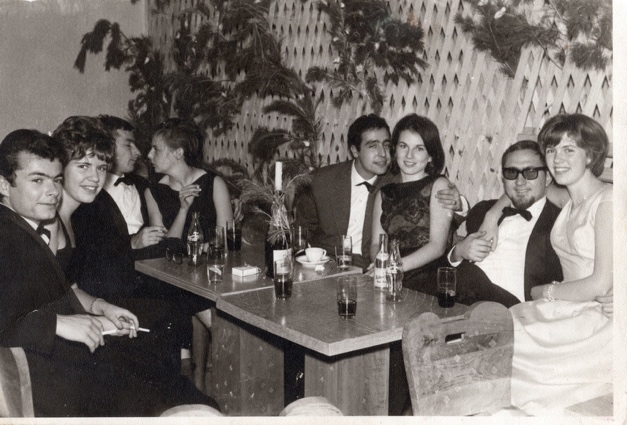
Kathy: This is me with Pedro over at the side. This is Teddy’s brother, Nene, with Bron. That’s what we looked like when we were 16 and17, Every New Year’s we would go to this bar, La Cubana, (I don’t know if it still exists). And right at midnight, everybody would be given twelve grapes, and with the ringing of the chimes of the great bell, piped in from the Cathedral in Madrid, we were supposed to eat a grape; and try to eat them all before midnight was struck. It was impossible. But that’s what everybody’s trying to do there.
Bron: And so, at the end of it, everybody’s got this mouthful of grapes and grape juice, and then everybody’s going around hugging and kissing, and the grape juice is falling all over the place. It was really a mess, but it was delightful. It was a lot of fun.
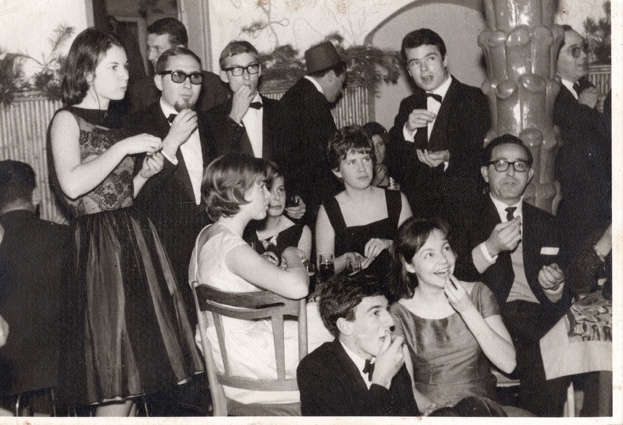
Kathy: And then the next morning, that’s when everybody walked down for a dip in the sea. Not me, I didn’t. Didn’t look like my sort of thing.
Bron: Neither did I.
Kathy: Anyway, that’s, it… How long have you [Michael] known William?
. .
Michael: I’ve known William since … the Children’s Poetry Conference …
[Laughter]
Kathy; Well, I don’t know if you’re interested, but all the children in the pictures that I have of them, they all look like Robert. I mean, look at the cheekbones of William. [Shows picture] Can you see? Definitely looks like Robert. All the pictures that I see, even Tomas [resembles Robert]. You can just make out the fact that he’s a Graves [by the cheekbones].
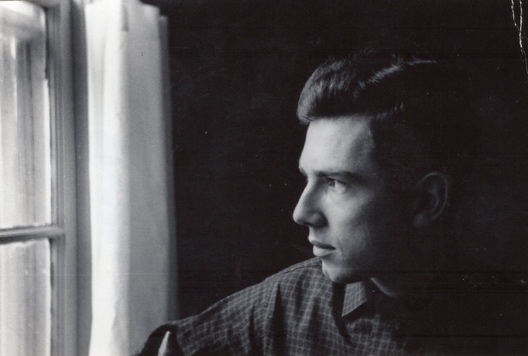
Bron: Our younger brother, Michael, I told him yesterday that we were going to be doing this talk, and I said, ‘do you have any memories about Robert? You were probably too young.’ And he sent me back a note saying, ‘the only thing I remember is that the villagers in Deià all called him Senor Tumbas.’
Bron: Did you know that?
Michael: No.
Bron: Senor Tumbas. Well, tumba is grave, or tomb. So, Graves and Tumbas, Senor Tumbas.
Bron: Our younger brother pulled that out of his memory.
Bron: Anyway… we’ve probably wrung ourselves dry here on Robert Graves’s memorabilia. Oh, look, Yes, this is a lovely book of the poems which he inscribed to Kathy.
[Kathy holds up copy of New Poems, inscribed ‘to Kathryn, Dec. 1963, Robert.’]
Kathy: ‘afectuosamente’
Kathy: And I remember when this came out just at that time, it’s dated there, 1963. And I remember William pointing out to me that the first poem, which is called ‘Ruby and Amethyst’, was about his mother, Beryl, and the muse. That was another world. All I knew from, just a quick glance at his bookcase, I guess I was allowed in there [Robert’s workroom] very briefly, was he had everything that Jane Austen ever wrote.
Bron: I thought I understood that William now runs the home basically as a museum for Robert Graves materials. Is that right?
Michael: Canellun is a museum now where you can see some of the artifacts from the life, and writing of Robert. His hat and cloak are still on a hook. And there’s a little movie of him. It’s the ‘Face in the Mirror’ movie.
Kathy: So, does William actually live in the house?
Michael Joseph: No, nobody lives in the house. The house next door is owned by Lucia. She will go there a few times a year [… with her family].
Bron: Kathy, [talk about] Ramon and the jazz club.
Kathy: [I was there when they] opened the jazz club, the Club Indigo.
Michael: There are stories of Robert being in that club, jovially embracing jazz performers, digging jazz.
Bron: Obviously the influence of his son-in-law, Ramon, was very strong.
Kathy: Well, I think he did it for Lucy, really.
Bron: I liked Ramon and I thought he was a fabulous jazz musician. Very, very talented. I remember hanging around with him. He was working in Barcelona then. He had a jazz club there. That was before they opened this one in Palma. I wasn’t there the year of that opening. I had left to go to university in Toronto the final year that our family was still in Mallorca.
.
Michael: Do you remember anything peculiar about the way Robert dressed?
Kathy: He was sloppy. He had this sort of scraggly beard that he shaved, but not very well, and that kind of thing. His hair was wild. He just looked scruffy. But he also looked perfectly comfortable in his rumpled shorts and loose cotton shirt.
Michael: Did you think of him as a great poet when you met him? That you were meeting this great poet or was he just William’s father?
Kathy: He was William’s father, but I knew that he had that reputation. It wasn’t until I saw I Claudius later, you know, the BBC series, that I said, ‘oh, wait a minute, this is really good. This is fun’. Although William reports that when he wrote those novels, they were almost written as potboilers and money makers.
Michael: Well, that’s the word [potboiler] that Robert himself uses. But they’ve won awards, those novels, and scholars have continued to study them and trace classical influences. And they take those books quite seriously as literature, though Robert, like William, dismissed them [saying] they were just to make money. But some people think the reason he said that was because his partner [during the 1930s when he was writing some of the novels], Laura Riding, was jealous of their popularity, and so, in order to allay her jealousy, he just made light of them. But I agree with you, I think they’re brilliant, I love them, I love that [BBC] series, too.
JonArno: When did you first read his books?
Bron: Not until later. We saw them sitting on the shelves. We didn’t read that kind of stuff yet.
JonArno: Did you both end up being fans of his work later on? Like, did you both read a lot of his books later?
Bron: I wouldn’t say that that happened. I’ve been meaning to, but we probably will now, after this conversation. I certainly want to read William’s book, the memoir. That would interest me. I remember trying to read The White Goddess when I was in my early twenties, and I was having a lot of trouble with it. I couldn't manage it very well.
Kathy: At the time I couldn’t understand the poetry, but I read it now with more understanding. But, no, I hadn’t even read I, Claudius, or Claudius the [God] at that time. I did read some of his Greek Myths. They were interesting, but way too scholarly for me back then.
Michael Well, the novels are … I have to say the novels are more fun than the myths.
Bron: You know, you have to remember that we were kids. We were kind of useless.
[Laughter]
Bron: All we were interested in was boys and boyfriends and dancing and music and stuff like that, right?
Kathy: We were just part of the scene, and yes, we enjoyed singing and getting together with friends such as Pedro, Po, Teddy, and of course, William.
Bron: Anyway, I think we’ve told you everything we can possibly [remember].
. .
Michael: JonArno, do we have any more questions?
JonArno: I think we covered … The last thing I might ask is do you remember which books [of Robert Graves’s] your parents had?
Kathy: I remember seeing I, Claudius on their shelves.
Bron: I think we had a copy of The White Goddess. Because I think my dad had been told by one of the producers he was working with at the CBC that this was something he should look at, and he probably brought it home and hardly ever looked at it, but I think it was on our shelf.
Kathy: The plays that our father performed in for the CBC were frequently one-hour radio adaptations of classic novels, poetry, and plays skillfully adapted for radio for the one-hour format. John Drainie, was considered first among equals in the Canadian acting community in the 40s, and 50s, and he was a wonderful actor. Unfortunately, he died very young, he was fifty, just after we came back from living in Spain. But it is possible that the reason any of those books, including ones by Robert Graves, were on our shelves was that he was, taking part in an adaptation. He was the kind of actor who liked to read beyond the script. and find out what the book was really all about. So he did his homework.
Kathy: We had a very eclectic sort of library for that reason. There was no order to it, it just depended upon what he was studying, or reading, or being a part of at that time.
Michael: Wow, that sounds great.
Bron: It was a great atmosphere to grow up in, that’s for sure.
Michael: We’ve talked for an hour, would you believe it?
Bron Well, it's been a pleasure. It’s been a delight, and it's wonderful to know the work you're doing, Michael.
Michael: Thank you, and we'll… I guess we’ll be in constant contact now.
Bron: And JonArno, thank you so much for being the midwife to all this. I mean, it was just because JonArno walked into this funny little bookstore where I sometimes work, and he puts a Robert Graves book down in front of me, and then I just started spewing.
[Laughter]
[Farewells affectionately exchanged.]
Michael: Interview terminated 22:32 PM
Bronwyn Drainie is a Canadian author and journalist, based in Toronto. She served as the editor of The Literary Review of Canada from 2003 until 2015, and the arts columnist and book reviewer for The Globe and Mail. She was also the producer and broadcaster for CBC Rado and the first host of Sunday Morning, CBC Radio's flagship Sunday program. She lived in Mallorca from 1961 to 1964 and had summer trips back to the island in 1976 and 1977.
Kathryn (Drainie) Pastor lived with her family in Mallorca from 1960 to 1964, and becoming close friends with Robert’s son, William, was introduced into the Graves family circle. She studied English Literature and Theatre at the University of Toronto, and went on to have a career teaching high school
NOTES